
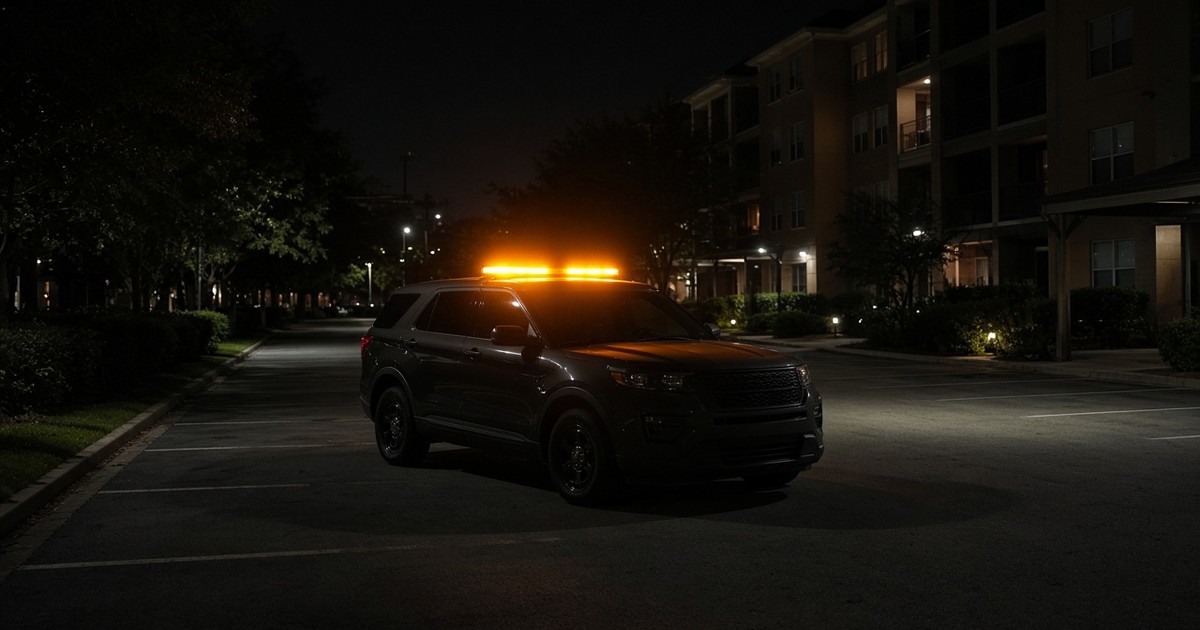
Not every property needs an officer on site all night, and not every property can get by with a few drive-by checks. Choosing between mobile patrol and a dedicated on-site guard comes down to how much activity your property sees, what you are protecting and how quickly someone needs to respond. Here is how each option works, where each one fits and how many Houston-area properties combine the two.
How mobile patrol works
With mobile patrol, an officer in a marked vehicle visits your property several times during set hours. Visits are timed at random, so anyone watching the property cannot predict when the next one will come. On each visit the officer checks gates, doors, lighting and parking areas, looks for signs of trespassing or damage, and logs what they found. If something looks wrong, the officer investigates and contacts police when needed. Because one officer covers several properties on a route, patrol is usually the more economical option.
How an on-site guard works
An on-site officer stays at your property for the whole shift. They can control who comes and goes, greet visitors and contractors, make regular rounds, watch cameras and respond the moment something happens. That constant presence is the strongest deterrent you can buy, and it gives tenants, employees or residents a person to go to. VantagePro offers both unarmed and armed officers, depending on the risk at the site.
Comparing the two side by side
- Cost: patrols generally cost less, because the officer's time is shared across a route. A dedicated officer is billed for every hour of the post.
- Response: an on-site officer responds immediately. A patrol officer responds during scheduled visits or when dispatched.
- Deterrence: both deter crime. Random patrol visits create uncertainty, while a full-time officer is a constant, visible presence.
- Access control: only an on-site officer can check credentials, manage a gate or sign in visitors throughout a shift.
- Flexibility: patrols are easy to scale up or down, add for holidays or pause when a property is busy.
When mobile patrol is enough
Patrol is often the right fit for HOA neighborhoods, vacant or for-lease buildings, small commercial lots, storage yards and properties with a low incident history. It also works well as an after-hours layer for businesses that are busy during the day but quiet at night. Our HOA security patrol guide covers how community patrol programs are typically set up.
When you need an on-site officer
A dedicated officer makes more sense when the property has steady foot traffic, a front desk or gate that needs to be staffed, valuable equipment or materials, an active construction phase, an event or a pattern of repeated incidents. If tenants or staff need someone to call right away, a patrol visit every few hours will not meet that expectation. For construction sites in particular, see our guide to construction site security in Houston.
When to combine both
Many properties use a mix. An on-site officer covers the busiest hours, such as business hours, evening amenity use or shift changes, while mobile patrols check the property overnight and on weekends. This gives you a visible presence when people are around and random checks when the property is quiet. Review incident reports after a few months to see whether the balance should change.
What a good security partner provides
Whatever coverage you choose, the company behind the officers matters as much as the hours on the schedule. Look for written post orders for each site, so every officer knows exactly what to check, whom to call and what to report. Ask how supervisors check on officers during shifts and how quickly a replacement arrives if someone is out sick.
Reporting is the other half of the job. VantagePro uses GPS checkpoints, timestamped photos and same-day incident reports, so clients can see the coverage they are paying for rather than taking it on trust. Good reports help police, insurers and property managers, and they reveal trends you can act on, such as a gate that keeps getting propped open or a lot that needs more lighting.
How to prepare for a security assessment
A short walk-through helps any security company recommend the right coverage. Before the visit, gather:
- A site map or floor plan with entrances, gates and parking areas
- A list of recent incidents, with dates and times if you have them
- Current camera, lighting and access-control details
- The hours when the property is most exposed
- Any requirements from your insurer, lender or management company
With that information, a provider can explain whether you need a fixed post, patrols, camera trailers or a mix, and why.
Frequently asked questions
How many times a night does a patrol visit?
It depends on your plan. Visits are scheduled within set hours and timed at random so they cannot be predicted.
Can a patrol officer lock and unlock gates?
Yes, if it is included in your post orders.
Is mobile patrol enough for a construction site?
For low-risk phases it often is. During high-risk phases, when expensive materials or equipment are on site, many projects add an on-site officer.
What should a security incident report include?
The time, location, people involved, what happened, the actions taken and photos where possible.
Talk with VantagePro Security
VantagePro Security is a veteran-owned, Texas DPS-licensed firm (License #B09419101) founded by career law enforcement professionals, with 60+ years of combined law enforcement experience in its leadership. We serve properties across Greater Houston. Request a quote or call (281) 335-6445 to talk through your site.
If you are in immediate danger
Call 911 first for any emergency or crime in progress. Our office line and request forms are for non-emergency coordination and follow-up coverage.